Risk Assessment

{riskassessment} ShinyGatherings x Pharmaverse Workshop

At a recent ShinyGatherings, some {riskassessment} contributors presented a workshop that focused on tailoring the application to org-specific risk requirements to simplify R package validation. Though we discussed the end-user experience, this workshop was really geared towards equipping “app deployers” to get the highest and best use out of the application for their organization’s specific needs. We appreciate Appsilon for the opportunity to speak about the application!


About the Workshop

The workshop’s main topics:

Continue reading

Risk Assessment App v3.1.1

Progress is continuing to be made in {riskassessment}. We wanted to share some of the enhancements and updates included in the most recent release of the application. There have been multiple releases, both minor and major, since our last post, so we have a lot of new content to cover!

But before we get into too much detail, if you are new to what we are doing in {riskassessment}, we would like to encourage you to check out our README. There you can find information regarding what {riskassessment} is seeking to accomplish and how you can install and deploy an instance of it for your personal or organizational use.

Continue reading

Risk Assessment App v2.0.0

Welcome! It’s with great excitement and long-awaited anticipation that I get to share some recent updates that have hit the {riskassessment} app’s GitHub repository earlier this month. If this is the first time you’ve heard or seen the application, I’d recommend starting with our README to gain some familiarity with the project, especially with installation instructions. However, (in a nut-shell) the app is a full-fledged R package that seeks augment the utility of the {riskmetric} package within an organizational context.

Continue reading

{riskassessment} App voted best Shiny app at shinyConf 2023! 🎉

The {riskassessment} app, presented by Aaron Clark from the R Validation Hub Executive Committee, was voted best Shiny app at shinyConf 2023. The 2nd Annual Shiny Conference was held in March 2023. It was all virtual with over 4k global registrants. Congratulations!!

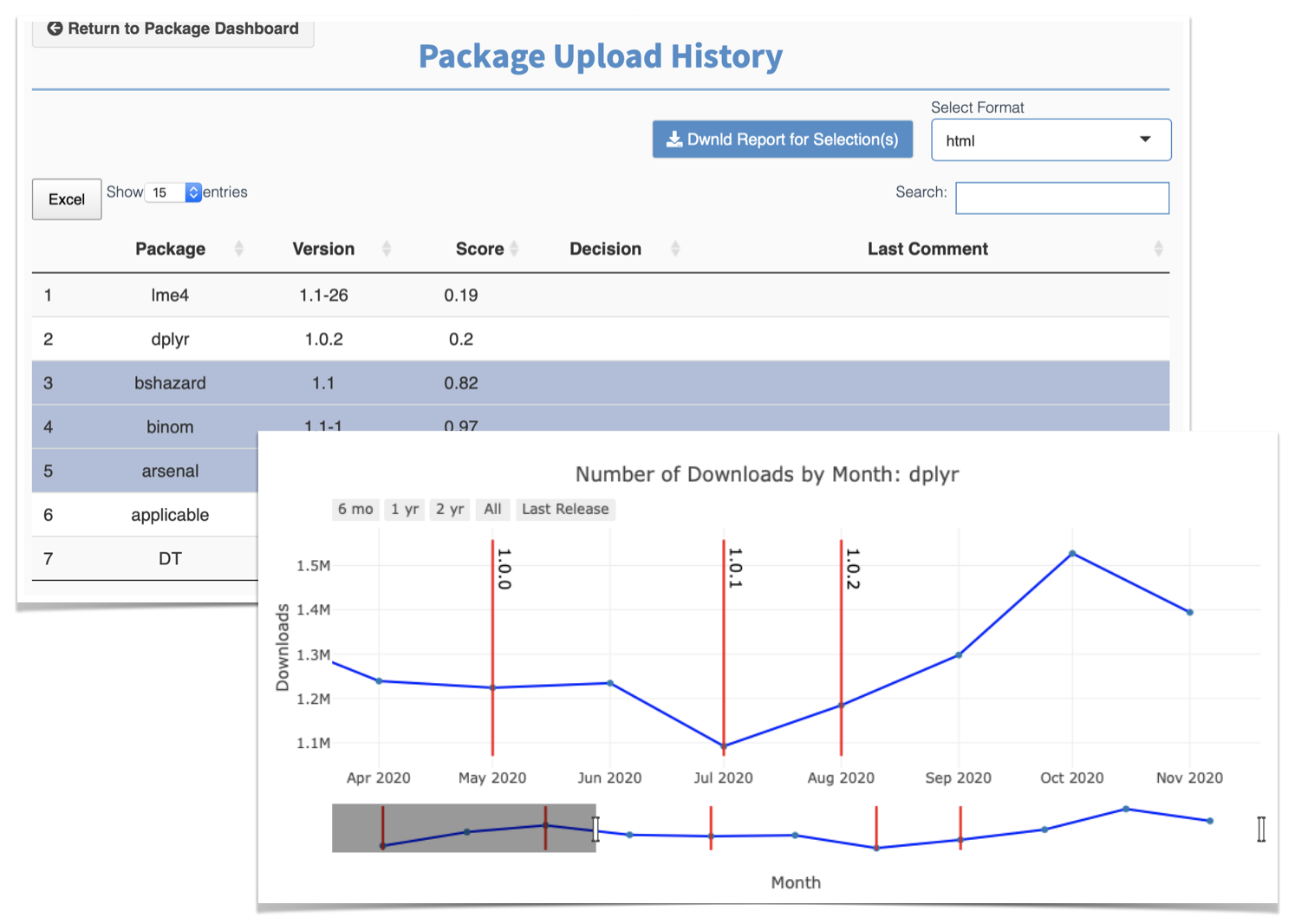
The app provides a shiny front-end to augment the utility of the {riskmetric} package, thus user-friendly and interactive access to risk assessment of R packages. The apps functionalities include:

Continue reading

ASA Biopharmaceutical report, Fall 2022

I’m pleased to share that the R Validation Hub’s efforts have been recognised in the ASA Biopharmaceutical report, Fall 2022. Within the edition you can find our paper, Risk Assessment of R Packages: Learnings and Reflections. This paper reflects on our white paper; provides an overview of our {riskmetric} package and Risk Assessment application; and summarises our 2022 case studies (which you can now find on our Case Studies page).

source: American Statistical Association

Continue reading

Risk Assessment App Update

This is a re-post. The original post from the R Consortium can be found here

Recent update by Marly Gotti on the Risk Assessment Shiny App. Marly is an executive committee member of the R Validation Hub where she advocates for the use of R within a biopharmaceutical regulatory setting, and Senior Data Scientist at Biogen.

The Risk Assessment App is an interactive web application serving as a front end application for the riskmetric R package. riskmetric is a framework to quantify risk by assessing a number of metrics meant to evaluate development best practices, code documentation, community engagement, and development sustainability. The app and riskmetric aim to provide some context for validation within regulated industries.

Continue reading

Status Update: MSA Framework by TransCelerate

TransCelerate has published “Modernization of statistical analytics (MSA) Framework”. With goals similar to the R Validation Hub, the TransCelerate MSA framework seeks to demonstrate software reliability by establishing principles of accuracy, traceability, and reproducibility for a modern analytical software environment.

The MSA framework is centered around risk-assessment and mitigation practices to demonstrate reliability of software. This framework suggests assessing the accuracy of a software library via a confidence measure built on risk metrics such as published source code, issue management, usage, maturity, etc. If confidence does not meet the highest standards, additional testing is recommended. In addition, the intended use of a particular software library and the impact to the broader business outcome determines the requirement for additional testing. Altogether, the MSA framework is in line with the suggestions published in the R Validation Hub 2020 white paper for R. While the TransCelerate authors suggest their principles apply to a broad range of software, e.g. SAS, R, Python, Julia, etc, they do not provide specific suggestions for the implementation of their framework. The R Validation Hub can support the implementation of MSA inspired features with the R package riskmetric and the respective shiny app.

Continue reading

Status Update: CRAN Release of `riskmetric`

We have reached a major milestone. The R package riskmetric has been released and is now available on CRAN.

What is riskmetric?

riskmetric is a collection of risk metrics to evaluate the quality of R packages following the framework suggested by the R validation hub (see our white paper for details). Various quality metrics are provided which evaluate best practices of software development, code documentation, community engagement and development sustainability. This package serves as a starting point for exploring the heterogeneity of code quality, and begin a broader conversation about the validation of R packages.

Continue reading

Status Update: Conferences 2021

The new year is starting with some good news for the R validation hub. We will be able to present our work at a number of different meetings in 2021:

Status Update: A summary of 2020

2020 was a busy year for the R Validation Hub. We released our white paper describing our current thinking on a risk based approach to using R for regulatory work. We started to support the implementation of the white paper with tools such as riskmetric and our risk assessment application. And we started a new sub-team with the aim of producing a follow-up white paper on testing. Throughout, we have continued to share and gain feedback on our proposed approach, presenting at User!; running a workshop at R/Pharma; and speaking at an EU Programming Heads meeting in June.

Continue reading